Image courtesy of PCC Galleries
Neural-Lithic Harvests: Hannah Newman at the Intersection of Technology and Nature
By Alayna Duke – 12/10/2025
Portland, Oregon – In a tiny room on the second floor of the Multnomah County Library, Hannah Newman sits across from me, wearing a bright sweater that seems to match her energy. She speaks with animated gestures and hands dancing in the air as her thoughts unfold. It’s impossible not to feel her excitement, a tangible sense of curiosity and wonder that mirrors the themes she explores in her art. “Maybe I am an artist, I just didn’t know,” she says, recalling the moment she realized her hands could craft not just objects, but ideas.
Newman’s journey into the arts is anything but traditional. Unlike many artists who discover their passion as children, she initially disliked drawing and avoided art classes. Her first love was color and space, which drew her toward interior design. But the technical constraints of that field left her unfulfilled. “Interior design is a lot of figuring out where an outlet needs to go, figuring out traffic patterns. And I was like, this isn’t for me,” she explains. It wasn’t until she took classes in sculpture and conceptual art that she began to see what making art could really mean, a revelation that opened the door to her current exploration of the intersection between humans and technology.
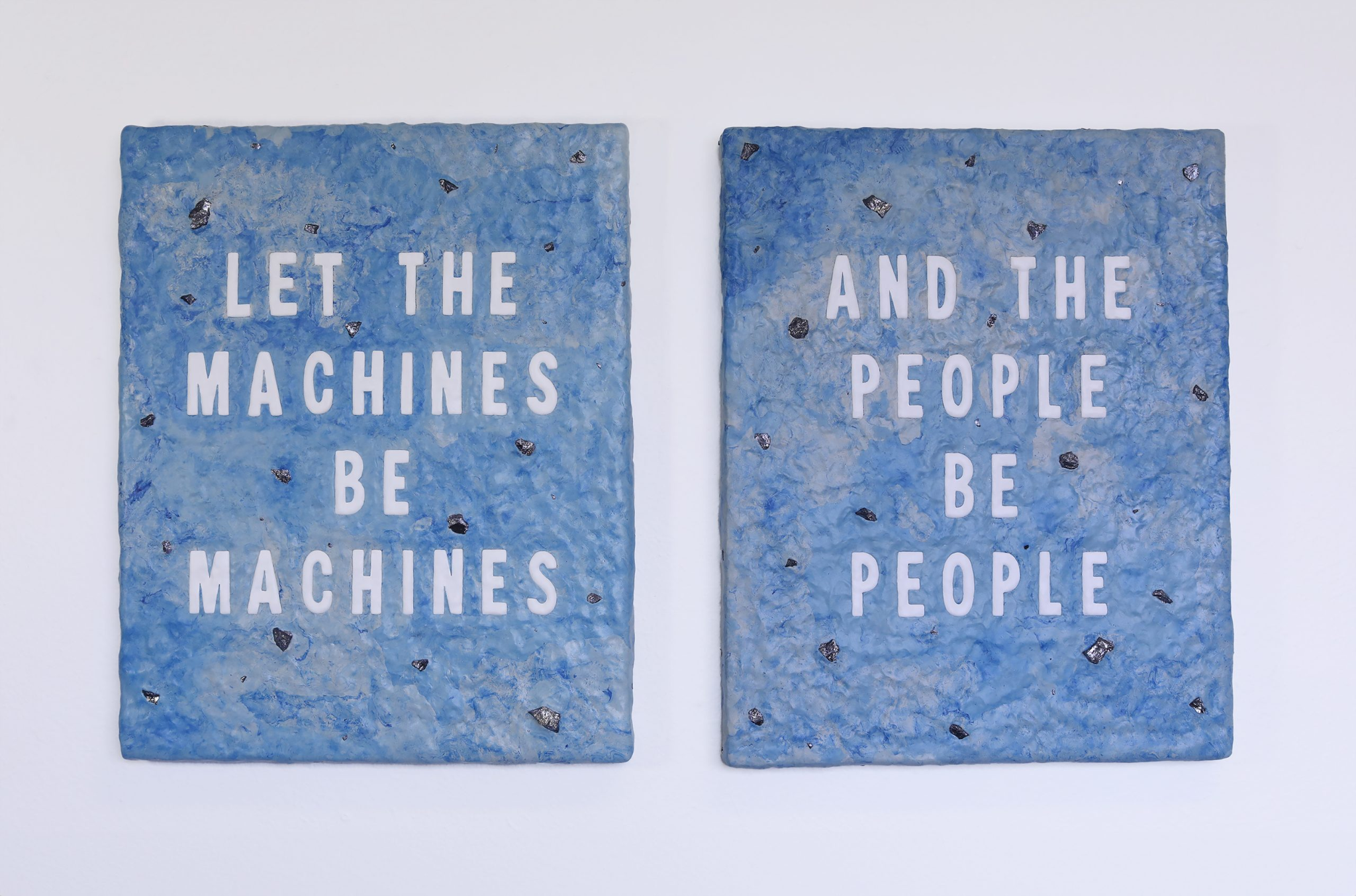
Newman’s work, on display in her current PCC exhibit Neural-Lithic Harvests, reflects a deep fascination with how digital technologies shape human experience while remaining deeply rooted in physical materials. Originally a ceramicist, she was drawn to hands-on creation with clay, yet she could not ignore the rise of digital technologies during her formative years. “I hated my Photoshop class in college,” she admits, “but I knew I was interested in what was happening in our digital lives.” Seeing how social media was taking over and smartphones were everywhere, Newman realized that technology was changing the way people connect with each other and the world around them.
Her approach to art reflects this duality. The powders she uses for colored glazes: copper, cobalt, lithium are the same materials powering the smartphones in our pockets. “When you carry your phone in your pocket, you’re carrying these distant geographies and economies and politics within your pocket. And what a wild thing that we’re all carrying this around and getting rid of them every two years because there’s a new upgrade,” she explains. Her sculptures, paintings, and sound pieces transform these abstract, digital phenomena into physical experiences that invite viewers to consider their relationship with technology, nature, and each other.
At the heart of Newman’s exhibit is a piece titled What a Time to Be Alive, paired with a one-minute AI-generated sound piece played through headphones. The AI voice repeats the phrase that inspired the title in shifting tones, from cheerful to somber, capturing the uncertainties and contradictions of our current moment and how we all experience technology differently. “It just captures everything I was thinking about in terms of what’s happening in our moment. What does it mean to be a human when machines are becoming more human-like?” Newman asks. For her, this pairing of visual and auditory art exemplifies the themes she continually explores: the interplay between humans and technology, and the ways digital life alters perception, interaction, and identity.
Newman’s creative process often incorporates artificial intelligence in unexpected ways. While experimenting with AI image generators, she found that tools alone rarely produce work that feels truly original. Instead, she uses them as collaborators, guiding the output and adding her own touches to create meaning. “The machine’s tone and inflection was adding new meaning to my work,” she explains. Her thoughtful use of AI underscores a core principle in her practice: technology is not a replacement for human creativity, but a lens through which to examine it.
Visitors to the PCC exhibit encounter more than digital commentary. Newman carefully integrates natural elements into her work, reminding audiences that technology does not exist in isolation. Leaves, clay, and other organic materials are interwoven with electronics and AI outputs, emphasizing that human lives, landscapes, and machines are deeply interconnected. “I’m very interested in thinking about what our connected lives mean, but also thinking about what those things mean for the environment,” she says. By blurring these boundaries, Newman challenges viewers to reconsider the role of technology in shaping not just society, but the physical world.
Meeting Newman, observing her animated storytelling and vibrant personality, adds another layer to experiencing her work. She speaks with the authority of someone who has thought deeply about her medium, yet remains open to discovery. Her passion has a way of drawing people in, encouraging them to consider the ethical, emotional, and societal aspects of technology. In this way, the exhibit functions not only as an art display, but as a conversation starter.
For Newman, art is not simply about aesthetics. It is a tool to ask questions, provoke reflection, and encourage dialogue. She hopes visitors leave the exhibit with a deeper understanding of artificial intelligence, its possibilities, and its potential pitfalls. Her work reminds us that while technology changes how we live, it also provides new opportunities for insight, expression, and connection.
Neural-Lithic Harvests is part of Newman’s ongoing exploration of the ever-shifting relationship between humans and machines. Through ceramics, painting, and AI-generated soundscapes, she creates immersive experiences that challenge our understanding of reality and technology. Her work underscores that creativity is not confined to traditional mediums, it thrives where curiosity meets skill, and where human hands engage thoughtfully with the digital world.
Ultimately, Hannah Newman’s journey is a testament to persistence, experimentation, and openness. She demonstrates how curiosity and reflection can guide both personal growth and artistic innovation. At PCC, she has created a space where visitors are encouraged to question, explore, and imagine what it means to exist in a world increasingly defined by technology. “Maybe I am an artist, I just didn’t know,” she states, a phrase that now carries the weight of her journey and the promise of the ideas yet to come.
Hannah Newman’s Neural-Lithic Harvests exhibit is on display at the PCC Art Gallery through December 2025. For more information, visit PCC Galleries.
Video Interview: https://www.youtube.com/watch?v=CJAnnFDle2M

